
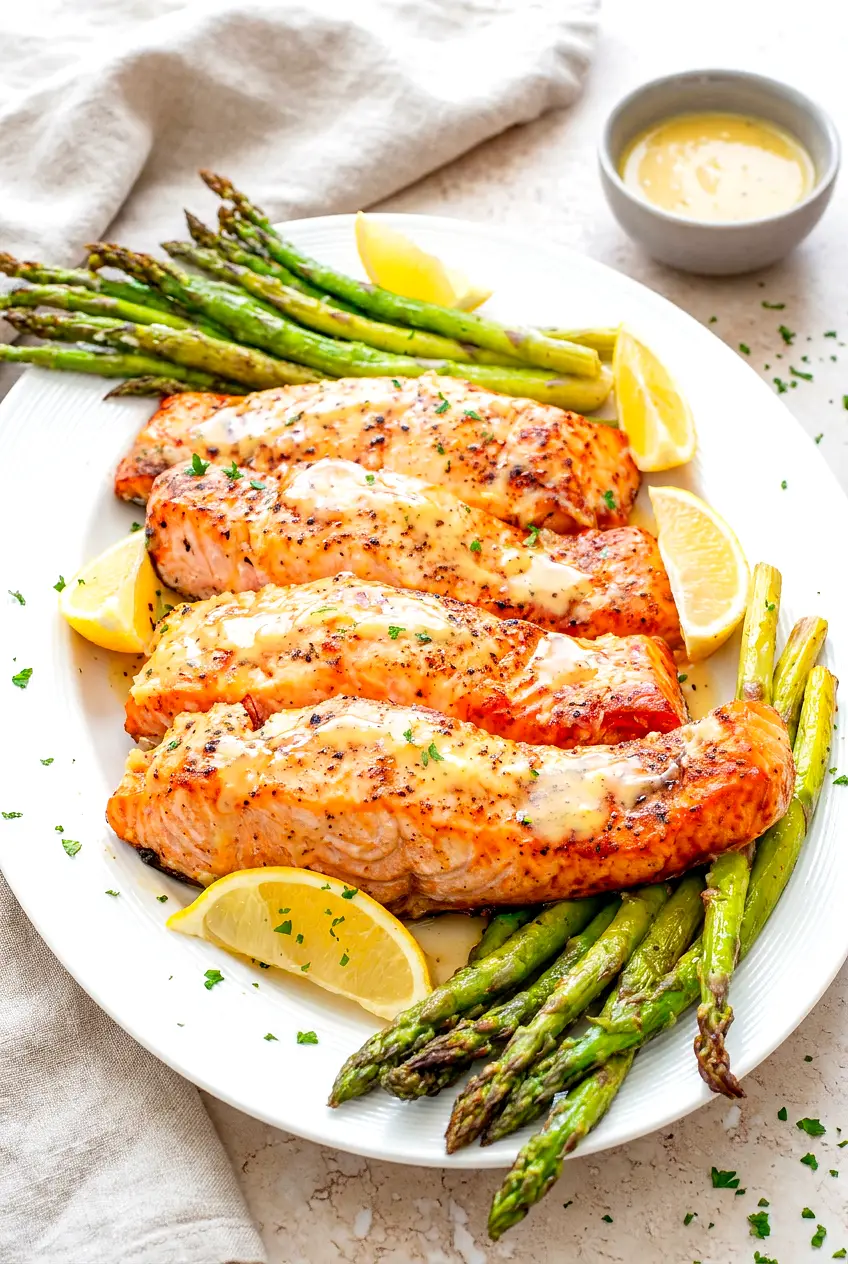
Air Fryer Salmon and Asparagus
What I like about this air fryer method is that the asparagus gets a short head start, then the salmon goes in and finishes quickly without needing to be flipped. I rely on the look of the fish more than the clock here, because air fryer models vary and salmon thickness changes the timing fast.
I’d rather keep the seasoning simple before cooking and save the lemon-garlic-honey Dijon mixture for the end. The sauce stays bright instead of scorching in the basket, the salmon stays moist, and you still get a fast one-basket dinner with very little cleanup.
Ingredients for Air Fryer Salmon and Asparagus
- 4 salmon fillets, skin-on or off, 5 to 6 ounces each (about 680g total)
- 1 pound asparagus, trimmed (450g)
- 2 tablespoons olive oil, divided
- 1 to 1 1/4 teaspoons fine sea salt, divided
- 1/2 teaspoon fine ground black pepper
- 1 large lemon, zested and juiced (2 tablespoons juice)
- 2 garlic cloves, minced
- 1 tablespoon honey
- 1 teaspoon Dijon mustard
Ingredient note: Medium asparagus spears work best here. Very thin spears can overcook before the salmon is done, while very thick spears may need a little more time.
If your salmon was frozen, thaw it fully first for the most even texture. Partially frozen fillets tend to steam and cook unevenly.
Optional for serving: 2 tablespoons chopped fresh parsley or dill, 1/4 teaspoon red pepper flakes whisked into the sauce, and lemon wedges or thin lemon slices.
How to Make Salmon and Asparagus in the Air Fryer

- Preheat and prep: Preheat the air fryer to 400°F (200°C) for 3 to 5 minutes if your model does not auto-preheat. Pat the salmon dry, trim the woody ends from the asparagus, and make sure both are fairly dry so they brown better instead of steaming.
- Whisk the sauce: In a small bowl, whisk together the lemon zest, lemon juice, garlic, honey, Dijon, and a small pinch of salt and pepper. Set aside. Do not add this before air frying, since the honey can burn.
- Season the asparagus: Toss the asparagus with 1 tablespoon olive oil, 1/4 to 1/2 teaspoon salt, and a few grinds of black pepper until lightly coated.
- Give the asparagus a head start: Arrange the asparagus in a single layer in the basket and air fry at 400°F (200°C) for 3 minutes. The tips should just start to soften.
- Season the salmon: Brush or lightly spray the salmon with about 1 teaspoon of the remaining oil. Season with the remaining 1/2 to 3/4 teaspoon salt and the rest of the pepper. If using skin-on fillets, place them skin-side down.
- Add the salmon and finish: Push the asparagus to the sides and place the salmon in the center so air can circulate around it. Air fry at 400°F (200°C) for 6 to 9 minutes more, depending on thickness. Do not flip the salmon. Shake or turn the asparagus once halfway through, and rotate the basket or tray if your air fryer browns unevenly.
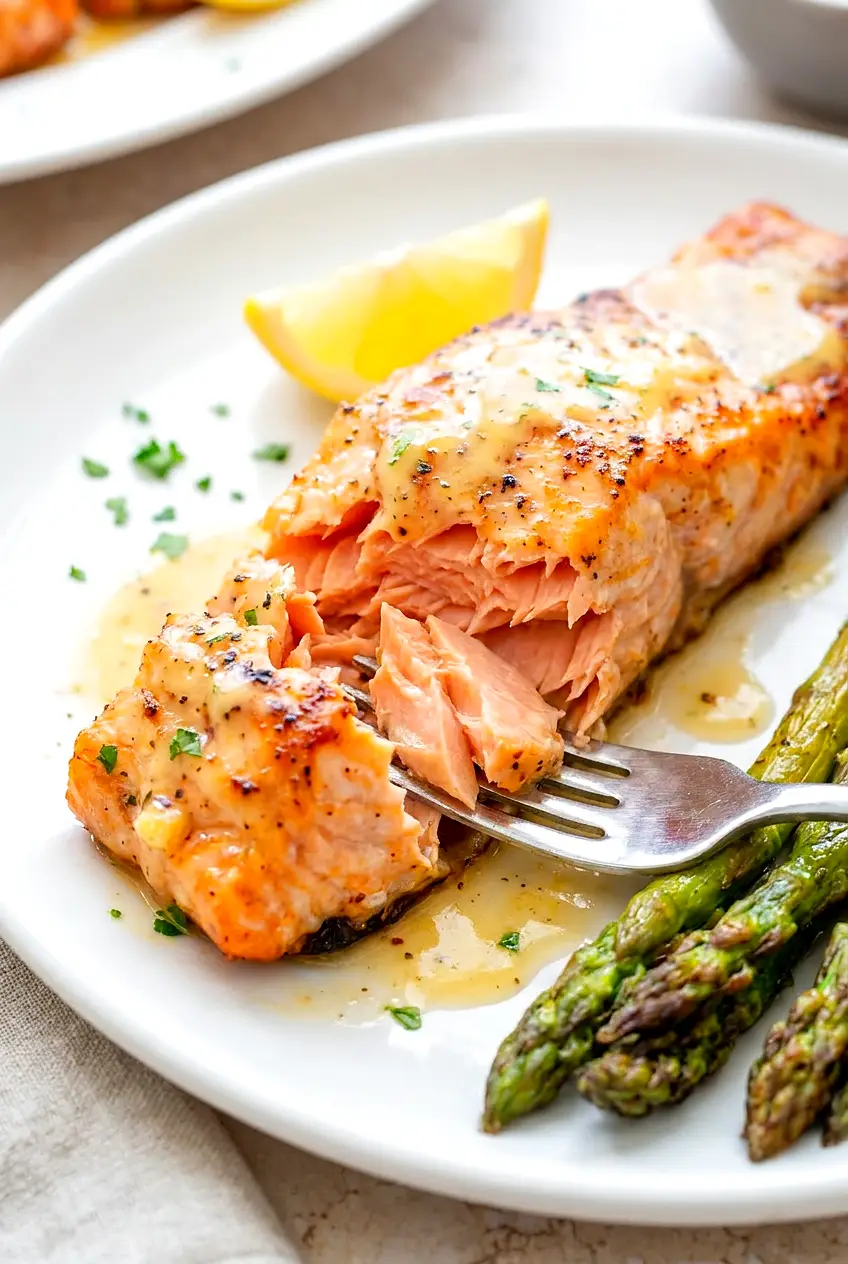
- Check doneness and rest: Start checking about 2 minutes early, especially if the fillets are thin or your air fryer runs hot. The part I pay attention to is the thickest section: it should be opaque and flake with light pressure, or read 145°F (63°C) on an instant-read thermometer. A little white albumin on the surface can show up right near doneness. Let the salmon rest for 2 to 3 minutes before saucing.
- Finish and serve: Drizzle the lemon-garlic-honey Dijon sauce over the warm salmon and asparagus. Add herbs and lemon wedges if you like, and serve right away.
Air Fryer Time and Temperature for Salmon and Asparagus
Cook the asparagus first at 400°F (200°C) for 3 minutes, then add the salmon and continue at the same temperature for 6 to 9 minutes.
Most fillets about 1 inch thick are done in that second cook window. Thicker center-cut pieces may need 1 to 2 minutes more, so start checking early instead of assuming one exact time will fit every basket.
Use time as a guide, not a guarantee. I usually look for opaque flesh that flakes easily in the thickest part, with 145°F (63°C) as the final doneness check.
How to Keep the Salmon Moist and the Asparagus Tender
The main thing that helps here is keeping the sauce off until the end. If it goes in early, the honey can darken too fast and the surface of the salmon can dry out before the center is done.
It also helps to keep everything in a single layer. I find this works best when the asparagus is pushed to the sides and the salmon sits in the center, since blocked airflow leads to softer asparagus and less even cooking.
If your basket is crowded, cook in batches rather than stacking. That matters more here than squeezing everything in at once.
Can You Cook Frozen Salmon in the Air Fryer?
Yes, but thawed salmon gives the best texture. If you need to start from frozen, cook the salmon alone at 400°F (200°C) for 5 to 6 minutes to thaw and begin cooking.
Then pat off any surface ice or moisture, season it, and add the asparagus. Continue cooking for 7 to 10 minutes more, checking by texture and temperature rather than time alone.
Expect the total cook time to run about 3 to 5 minutes longer, depending on thickness.
Variations
Air Fryer Salmon, Asparagus, and Potatoes
For a fuller one-basket meal, add 12 ounces small diced potatoes tossed with oil and salt. Air fry the potatoes at 400°F (200°C) for 10 minutes first, then add the asparagus for 3 minutes, then add the salmon for 6 to 9 minutes. Cut the potatoes into 1/2-inch pieces so they cook through in time.
Salmon and Asparagus in Foil in the Air Fryer
If you want easier cleanup and do not mind a softer texture, place the salmon and asparagus in a loosely sealed foil packet with the sauce and air fry at 400°F (200°C) for 10 to 14 minutes. This version steams more than it browns, so it is better when you want a gentler cook than crisp edges.
What to Serve with Air Fryer Salmon and Asparagus
Serve this over rice, quinoa, or couscous if you want something to catch the sauce. It also works well with roasted or mashed potatoes.
Extra lemon wedges and fresh herbs fit naturally here. For a more sauce-forward version, try our Air Fryer Teriyaki Salmon.
How to Store and Reheat Air Fryer Salmon and Asparagus
Refrigerate leftovers in an airtight container for up to 2 days. If you can, store the sauce separately so the salmon and asparagus do not soften as much.
Reheat the salmon gently in the air fryer at 300 to 320°F (150 to 160°C) for 3 to 4 minutes, just until warmed through. Do not overdo it, since salmon dries out quickly on reheat.
Asparagus softens in storage, so reheat it briefly or serve it cold alongside the salmon. Cooked asparagus does not freeze well.
Cooked salmon can be frozen for up to 2 months, though the texture may be a little drier after reheating. Leftover salmon is also good cold in grain bowls or salads, or turned into Crispy Air Fryer Salmon Croquettes.
Nutrition
Approximate nutrition per serving, based on 4 servings: 390 calories, 35g protein, 23g fat, 9g carbohydrates.
Approximate serving size: 1 salmon fillet with 1/4 of the asparagus and sauce.
Approximate nutrition per 100g: 175 calories, 16g protein, 10g fat, 4g carbohydrates.
Nutrition is an estimate and will vary with the size of the fillets, how much oil remains in the basket, and any optional garnishes or sides.
Air Fryer Salmon and Asparagus
Equipment
- air fryer
- mixing bowl
- small bowl
- whisk
- pastry brush
- instant-read thermometer
Ingredients
For the salmon and asparagus
- 4 salmon fillets, skin-on or off, 5 to 6 ounces each (about 680 g total)
- 1 pound asparagus, trimmed (450 g)
- 2 tablespoons olive oil, divided
- 1 to 1 1/4 teaspoons fine sea salt, divided
- 1/2 teaspoon finely ground black pepper
For the lemon-garlic-honey Dijon sauce
- 1 large lemon, zested and juiced (about 2 tablespoons juice)
- 2 garlic cloves, minced
- 1 tablespoon honey
- 1 teaspoon Dijon mustard
- small pinch salt and pepper
Optional for serving
- 2 tablespoons chopped fresh parsley or dill (optional)
- 1/4 teaspoon red pepper flakes whisked into the sauce (optional)
- Lemon wedges or thin lemon slices (optional)
Instructions
- Preheat the air fryer to 400°F (200°C) for 3 to 5 minutes if your model does not auto-preheat.
- Pat the salmon dry and trim the woody ends from the asparagus; make sure both are fairly dry so they brown instead of steaming.
- In a small bowl, whisk together the lemon zest, lemon juice, minced garlic, honey, Dijon mustard, and a small pinch of salt and pepper; set the sauce aside.
- Toss the asparagus with 1 tablespoon olive oil, 1/4 to 1/2 teaspoon salt, and a few grinds of black pepper until lightly coated.
- Arrange the asparagus in a single layer in the air fryer basket and air fry at 400°F (200°C) for 3 minutes.
- Brush or lightly spray the salmon with about 1 teaspoon of the remaining oil and season with the remaining salt and the rest of the pepper; if using skin-on fillets, place them skin-side down.
- Push the asparagus to the sides and place the salmon in the center so air can circulate; air fry at 400°F (200°C) for 6 to 9 minutes more, do not flip the salmon, and shake or turn the asparagus once halfway through cooking.
- Start checking doneness about 2 minutes early; the thickest part should be opaque and flake with light pressure or read 145°F (63°C) on an instant-read thermometer.
- Let the salmon rest for 2 to 3 minutes, then drizzle the lemon-garlic-honey Dijon sauce over the warm salmon and asparagus and serve with optional herbs and lemon wedges.
Tips
- Keep the sauce off the salmon until after cooking to prevent the honey from burning and to keep the sauce bright.
- Cook everything in a single layer and place the salmon in the center for best airflow and even browning.
- Thaw frozen salmon fully before cooking for the most even texture; partially frozen fillets can cook unevenly.
- Start checking doneness early, especially for thin fillets or hot-running air fryer models.
- Medium asparagus spears work best; very thin spears can overcook and very thick spears may need extra time.
Variations
- Air Fryer Salmon, Asparagus, and Potatoes: Add 12 ounces small diced potatoes tossed with oil and salt; air fry the potatoes at 400°F (200°C) for 10 minutes first, then add the asparagus for 3 minutes and the salmon for 6 to 9 minutes.
- Salmon and Asparagus in Foil in the Air Fryer: Place the salmon and asparagus in a loosely sealed foil packet with the sauce and air fry at 400°F (200°C) for 10 to 14 minutes for a steamed, softer texture and easier cleanup.